
If you’ve searched for the personal tax exemption in Canada, you’ve probably found one answer that sounds simple and a second that seems to contradict it.
The confusion is understandable. The phrase is everywhere, but Canada’s tax system doesn’t actually use it. What it uses instead is a tax credit that does almost the same job.
This guide explains what that credit is, how much it’s worth in 2026, who gets it, how it differs from province to province, and how to make sure you’re using it properly. It also covers what income is tax-free, and what else you can do to lower your tax bill.
If you only want one takeaway, it’s this: you almost certainly already benefit from it, but understanding it helps you plan.
What Is the Personal Tax Exemption in Canada?
In many countries, a personal exemption is a fixed amount you subtract from your income before tax is calculated. Canada moved away from that model decades ago and now uses credits instead.
So when people ask about the personal tax exemption in Canada, what they usually mean is the basic personal amount (BPA).
The BPA is the amount of income every Canadian resident can earn without paying federal income tax. It isn’t something you apply for or earn. It’s built into the tax system and available to nearly everyone who files a return.
Here’s how it works in one sentence. The government treats a set amount of your income as if it weren’t taxable, by giving you a credit worth that amount multiplied by the lowest federal tax rate. The credit then reduces the federal tax you owe, dollar for dollar. In effect, your first slice of income is taxed at zero.
Two ideas are worth separating here, because they get mixed up constantly:
- A deduction lowers your taxable income. Its value depends on your tax bracket.
- A credit lowers your tax directly. Because the BPA is calculated at the lowest rate, it’s worth the same to everyone, whatever their bracket.
That’s why the BPA feels like an exemption, even though technically it isn’t one.
What Is the Basic Personal Amount in Canada for 2026?
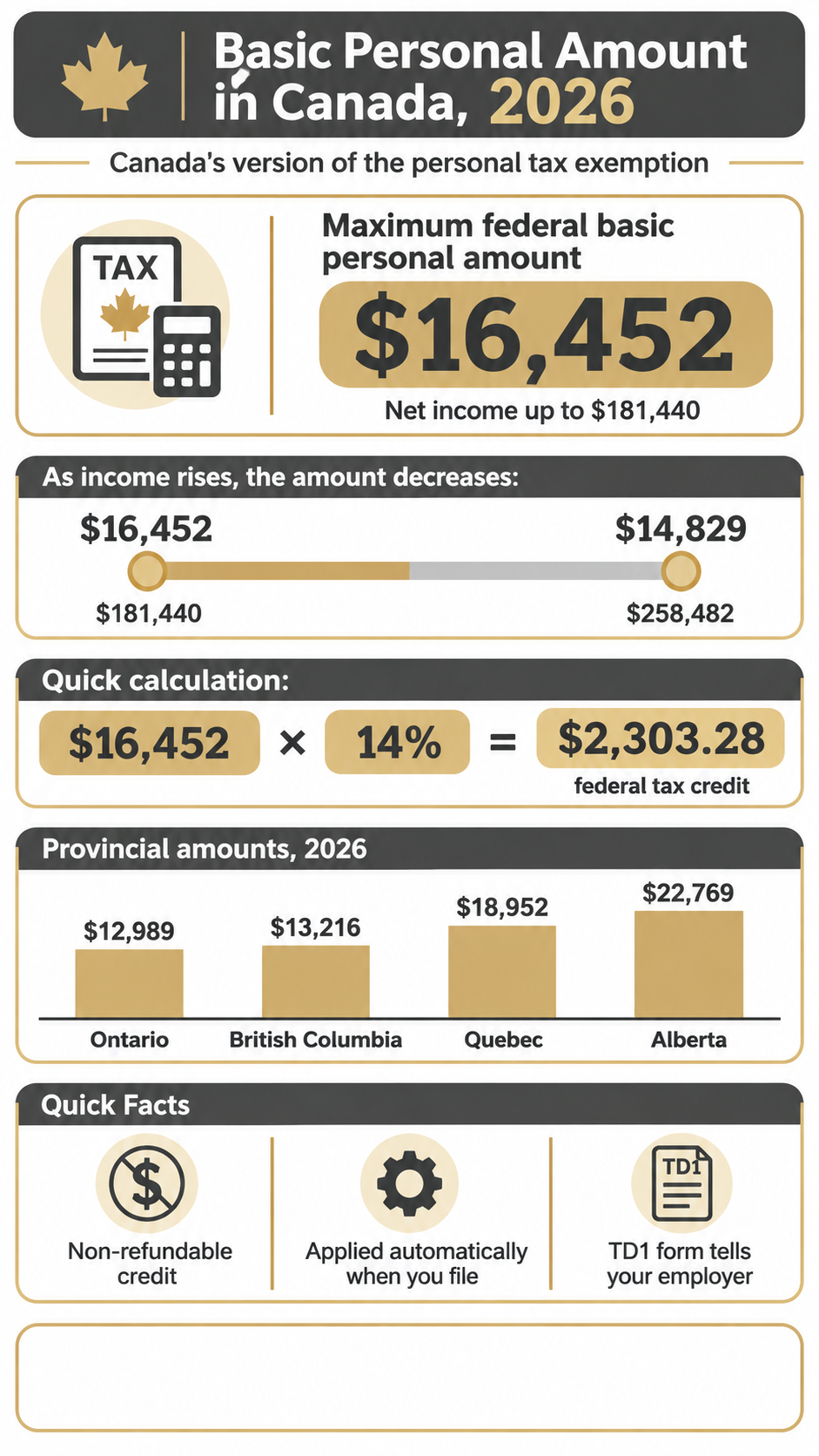
For 2026, the maximum federal basic personal amount is $16,452. In plain terms, that is the first $16,452 of income you can earn before federal income tax applies, for people with a net income up to $181,440.
The BPA isn’t one flat number for everyone. It has a maximum and a minimum:
- Maximum: $16,452. This applies if your net income is $181,440 or less.
- Minimum: $14,829. This applies if your net income is $258,482 or more.
- In between: The amount is reduced gradually as your net income rises from $181,440 to $258,482.
Behind the scenes, the BPA is made of two parts: a base amount of $14,829 and an additional amount of $1,623 that phases out as income climbs. That’s why higher earners see a smaller figure.
The amount is also indexed to inflation, so it generally rises a little each year. That’s why you’ll see a different number depending on the year you’re looking at. Always check the figure for the tax year you’re filing, not the one from last year’s article.
One caution: the BPA applies to net income, which is your total income minus certain deductions like RRSP contributions. A deduction can sometimes pull your net income back under a threshold, which is one more reason planning matters.
How Does the Basic Personal Amount Work?
It’s a non-refundable credit
The BPA is a non-refundable tax credit. That means it can reduce the tax you owe to zero, but it can’t create a refund by itself. If the credit is bigger than your tax, the extra simply goes unused. It doesn’t carry forward, and you don’t get it back as cash.
How the federal credit is calculated
The formula is straightforward:
BPA × lowest federal tax rate = federal tax credit
For 2026, the lowest federal rate is 14%. So:
$16,452 × 14% = $2,303.28
That’s the maximum federal tax reduction the BPA gives you, and it comes off the tax you calculate before other credits.
Two examples
Example 1: You earn $15,000. Federal tax on $15,000 at 14% is $2,100. Your BPA credit is $2,303.28, which is more than the tax. Your federal income tax on that income is $0. The unused $203.28 doesn’t turn into a refund, and it doesn’t carry forward.
Example 2: You earn $40,000. Federal tax at 14% on $40,000 is $5,600. Subtract the BPA credit of $2,303.28 and you get $3,296.72 in federal tax, before other credits such as those for CPP and EI contributions. The BPA effectively cut your federal bill by more than $2,300.
Notice something about those numbers: the credit is the same $2,303.28 for both people. A credit doesn’t care how much you earn. That’s the part many people find surprising.
Who Is Eligible for the Personal Tax Exemption in Canada?
Eligibility is broader than most people expect. There’s no application, no minimum income, and no age requirement. What matters is mainly your residency for tax purposes.
Canadian residents
If you’re a resident of Canada for tax purposes, you can claim the BPA when you file. This applies whether you work, study, are retired or have no income at all.
Newcomers and immigrants
If you arrived in Canada partway through the year, your first return usually covers only the period you were a resident. Many credits, including the BPA, are often prorated for that partial year, although some situations allow a full claim.
Because the answer depends on your arrival date and your income, it’s one to confirm before filing.
Temporary residents
International students and temporary workers aren’t automatically excluded. What counts is whether you’re a resident for tax purposes, which depends on your ties to Canada: a home here, a spouse or dependants, bank accounts and similar connections.
If you are a resident, you’re generally treated like any other resident for the BPA.
Non-residents
Non-residents are treated differently. As a general rule, they can claim personal credits like the BPA only if at least 90% of their worldwide income is included in their Canadian taxable income.
Otherwise, the credit is typically not available. Because cross-border situations get complicated quickly, it’s worth getting advice if this might apply to you.
Is the Personal Tax Exemption Different Across Canadian Provinces?
Yes. Every province and territory sets its own basic personal amount and applies it to its own tax. The credit is worked out the same way as the federal one, using the lowest provincial rate. The amounts vary a lot.
| Province | 2026 basic personal amount |
| Ontario | $12,989 |
| British Columbia | $13,216 |
| Alberta | $22,769 |
| Quebec | $18,952 |
| Prince Edward Island | $15,000 |
| Manitoba | $15,780 (reduced for higher incomes) |
Ontario
Ontario’s BPA is $12,989 for 2026, and the credit is worked out at Ontario’s lowest rate of 5.05%. That’s about $656 in provincial tax savings. Add the federal credit of $2,303.28, and the two together reduce a typical Ontario resident’s combined tax by roughly $2,960.
British Columbia
BC’s BPA is $13,216, a little higher than Ontario’s.
Alberta
Alberta has the highest basic personal amount in the country at $22,769, so Alberta residents can earn considerably more before provincial tax applies.
Quebec
Quebec works differently. Residents file a separate provincial return with Revenu Quebec, and the province has its own BPA of $18,952. Quebec residents also receive a 16.5% abatement on their federal tax.
Other provinces and territories
The other provinces and territories each have their own amounts, and some reduce the credit for higher earners. These figures change from year to year, so check the current amount for where you live.
What Income Is Tax-Free in Canada?
The BPA and employment income
The BPA does mean you can earn up to $16,452 in 2026 without owing federal income tax. But that isn’t the whole story, for three reasons.
First, provincial tax starts at a different point. In Ontario, for example, provincial tax begins above $12,989, even though federal tax doesn’t begin until $16,452.
Second, payroll deductions are separate. Even on a small income, your employer may still deduct CPP and EI contributions, because the BPA doesn’t exempt you from those.
Third, other credits can push your true tax-free point higher. The Canada employment amount and the credits for CPP and EI contributions all reduce your tax too, so the real threshold depends on your whole situation.
If your income is below the BPA, you might not owe any tax, but your employer may have withheld some. Filing a return is how you get it back.
And if your income is modest and your situation is simple, a free tax clinic can prepare the return for you. The CRA explains who qualifies in its Community Volunteer Income Tax Program information.
Tax-exempt income sources
Some types of money aren’t taxed at all, whatever your income level:
- TFSA growth and withdrawals. Investment income inside a TFSA isn’t taxed.
- Gifts and inheritances. Canada has no inheritance or gift tax for the recipient, though the estate may have its own tax obligations.
- Lottery winnings. Prizes are generally tax-free for the winner.
- Life insurance death benefits. These are generally received tax-free.
- Child support received. The recipient doesn’t report it as income.
- Gains on a principal residence. The principal residence exemption can shelter the gain when you sell, though the sale should still be reported.
- Certain scholarships and bursaries. These are often tax-free for full-time students in qualifying programs.
Government benefits
Several benefits are non-taxable, including the GST/HST credit, the Canada Child Benefit and the Canada Workers Benefit. But not all benefits are tax-free. Employment Insurance, Canada Pension Plan benefits and Old Age Security are taxable, so they count as income.
What Is the Difference Between Federal and Provincial Personal Tax Credits?
Federal basic personal amount
The federal BPA reduces your federal income tax. It’s calculated at the federal lowest rate, 14% in 2026, and it works the same way across the country.
Provincial and territorial basic personal amounts
Each province and territory has its own BPA and its own lowest rate. That credit reduces only your provincial tax. A higher BPA in a province means a higher provincial tax-free threshold.
How they work together
Think of it as two separate calculations that add up. You calculate federal tax and subtract the federal credits. You calculate provincial tax and subtract the provincial credits. Your total tax is the combination of both, and each BPA only affects its own half.
That’s why two people with the same income can have different tax bills in different provinces, even though the federal part is identical. Quebec is the exception, because the provincial return is filed separately.
How Can You Claim the Basic Personal Amount on Your Tax Return?
Claiming the BPA when you file
You don’t need to apply for the BPA, and you don’t need to ask for it. Tax software and a preparer add it automatically when you file your personal tax return. It appears as one of the personal amounts that reduce your federal tax. If you’d rather have someone handle the filing for you, our personal tax filing service does exactly that.
For the 2026 tax year, the return is due April 30, 2027. You can confirm dates on the CRA’s filing and payment dates for individuals. Before you sit down to file, it helps to have your slips and receipts in one place, and our tax documents checklist for Canada lists what to gather.
Understanding the TD1 Personal Tax Credits Return
The BPA also matters earlier in the year, through your paycheques. When you start a job, your employer asks you to complete a TD1 Personal Tax Credits Return, which is a form that tells them which credits you plan to claim. There’s a federal version and a provincial one.
Your employer uses that information to decide how much tax to take off each paycheque. If you don’t submit one, they generally apply only the basic personal amount.
If you have other credits, such as a spouse amount or a disability amount, updating the form means less tax withheld up front and fewer surprises at filing time.
Self-employed people don’t use a TD1, because they don’t have an employer withholding tax. If that’s you, our self-employed tax filing service can walk you through installments and credits.
What happens if you have multiple employers?
You only get one BPA, no matter how many jobs you have. A common approach is to claim your personal amounts with one employer and claim zero on the second employer’s form, so you aren’t under-withholding. If both employers apply the full credit, you can end up owing tax at filing.
When you’re juggling two jobs, check your withholding with your payroll contact or a tax professional. For more slip-ups worth avoiding, see our guide to common tax mistakes in Canada.
How Can You Reduce Your Personal Income Tax in Canada?
The BPA is automatic, but there’s a lot more you can do, and the best time to do it is before year-end. Our year-end tax planning checklist for 2026 walks through the timing in more detail. These are the most common ways to lower your bill.
RRSP contributions
RRSP contributions reduce your taxable income, and they’re often the biggest lever people have. For the 2026 tax year, you can contribute until March 1, 2027 and still deduct it on your 2026 return. Because the deduction also lowers your net income, it can help you stay under income thresholds that shrink certain credits.
TFSA investment income
A TFSA doesn’t give you a deduction, but the growth and withdrawals are tax-free. The 2026 contribution limit is $7,000. Check your room before you contribute, since over-contributions are penalized.
Eligible medical expenses
Medical costs above a set threshold can earn a credit. You can pick any 12-month period ending in the tax year, which lets you choose the window with the largest total.
Charitable donations
Donations to registered charities earn a credit, and the portion above $200 earns a higher one. You can combine donations with a spouse and carry unclaimed amounts forward for up to five years.
Tuition tax credits
Students get a credit for eligible tuition fees, and unused amounts can be carried forward or partly transferred to a parent or spouse. If this applies to you, our student tax return service can help with the details.
Other eligible deductions and credits
Depending on your situation, you may also qualify for childcare expenses, moving expenses, union or professional dues, the Canada caregiver credit and the disability tax credit.
The right mix depends on your circumstances, and a short planning conversation can uncover claims you didn’t know about. Our tax planning service is built around exactly that.
Frequently Asked Questions About Personal Tax Exemption in Canada
How much income can I earn tax-free in Canada in 2026?
Federally, up to $16,452 for most people, through the basic personal amount. Provincial tax has its own threshold, such as $12,989 in Ontario, and payroll deductions like CPP and EI still apply. Other credits can also raise the point where you start owing tax.
Is the Basic Personal Amount the same in every province?
No. The federal amount is the same everywhere, but each province and territory sets its own. Alberta’s is the highest at $22,769, while Ontario’s is $12,989.
Do newcomers to Canada qualify for the Basic Personal Amount?
Yes, if they become tax residents. In the year of arrival, the amount is often prorated for the part of the year they were residents, so the timing of arrival matters.
Can international students claim the personal tax exemption?
If an international student is a resident of Canada for tax purposes, they can generally claim the BPA like any other resident. Residency depends on their ties to Canada, not on their visa alone.
Do I need to apply for the Basic Personal Amount?
No. There’s nothing to apply for. You claim it by filing your return, and you can also give your employer a TD1 form so your paycheques reflect it.
Is the Basic Personal Amount automatically applied to my tax return?
Yes. Tax software and preparers apply it automatically. The amount may be reduced if your net income is high, but you don’t have to request it.
Final Thoughts: Understanding Your Personal Tax Exemption in Canada
There’s no personal tax exemption in Canada in the old-fashioned sense, but the basic personal amount does the same job and does it for nearly everyone. For 2026, that’s up to $16,452 of income that isn’t subject to federal tax, with each province adding its own amount on top.
The key points to remember: it’s a non-refundable credit worth the same to everyone, it’s applied automatically when you file, it’s prorated or limited in some situations such as arriving partway through the year or being a non-resident, and it’s only one piece of the picture.
Credits like tuition and donations, and deductions like RRSP contributions, can lower your bill further.
If you’d like help applying all of this to your own return, Taxwala Tax & Accounting helps individuals, families, students and newcomers with Canadian personal income tax filing and tax planning, from claiming every credit you’re entitled to, to planning ahead for next year.
We’re a Waterloo, Ontario firm that has served clients since 2012, in person across Waterloo, Kitchener and Cambridge, and online across Canada. Book a Free Consultation and we’ll walk you through what applies to you.