
Most people think about taxes in March or April, when the slips arrive and the stress starts. By then, a lot of your options are gone.
The money you could have put toward an RRSP, the donation you meant to make, the investment loss you could have used to offset a gain: all of it is tied to what happens before December 31.
That’s why year-end tax planning in Canada is worth an hour or two this fall. You don’t need to become a tax expert, and you don’t need a spreadsheet with forty tabs.
You just need to know where you stand while there’s still time to change something.
This checklist walks through what we look at with clients every year, in roughly the order we’d tackle it.
It’s written for employees, families, self-employed professionals and small business owners, so some sections will matter more to you than others. Skip what doesn’t apply. Spend your time on what does.
Why Year-End Tax Planning Matters in Canada
Canada taxes you on a calendar-year basis, so what counts for 2026 is mostly decided by December 31, 2026. A few things, like RRSP contributions, can still be done afterward. Many can’t. A charitable donation made on January 2 belongs to 2027.
An investment sale that doesn’t settle in time lands in the wrong year. A childcare receipt you never collected stays uncollected.
Looking at your numbers now gives you three things. First, a realistic estimate of your taxable income, which tells you whether you’re heading for a refund or a bill. Second, a list of deductions and credits you can still act on. Third, time.
A decision made in November is calm and considered. The same decision made on the last afternoon of December, or after the deadline has passed, usually isn’t.
This is also the kind of review that tax planning is designed around: looking ahead at the year while it’s still open, instead of cleaning up after it closes.
Even if you do the whole checklist yourself, you’ll start tax season with your paperwork in order and a good idea of what your return will look like. That alone takes a surprising amount of stress out of filing.
2026 Year-End Tax Planning Checklist
Review Your Annual Income
Start by adding up everything you’ve earned so far this year, not just your main paycheque. Employment income is the easy part.
You’ll also want to include self-employment income, rental income, investment income (interest, dividends and capital gains) and anything else that’s taxable, such as a side gig, a one-time bonus, or a payment from a former employer.
A late-year pay stub is a handy shortcut for employment income, since it shows year-to-date earnings. For everything else, your bank and brokerage statements will get you most of the way there.
Why bother now? Because the total tells you roughly which tax bracket you’re landing in, and that shapes almost every decision below.
An RRSP deduction is worth more at a higher income. A capital loss only helps if you have gains to offset. If you changed jobs mid-year, took parental leave, started freelancing or retired, your income may look quite different from last year, and your personal tax return will too. Check it before you assume anything.
Also look at what wasn’t withheld. Employment income usually has tax taken off at source. Rental income, interest and side income often don’t, and the bill arrives all at once in the spring.
Review Your RRSP Contributions
RRSP contributions reduce your taxable income, so they’re often the biggest planning lever people have. Your room is generally 18% of the previous year’s earned income, up to an annual limit, plus any unused room carried forward.
The CRA explains how your RRSP deduction limit is calculated, but your exact number is on your latest Notice of Assessment or in your CRA My Account. Don’t guess it.
Here’s the part that surprises people: you don’t have to contribute by December 31. For the 2026 tax year, the deadline is 60 days after year-end, which falls on March 1, 2027.
Contributing in that window still lets you claim the deduction on your 2026 return. Many people use it because by then they know their final income.
A few things to keep in mind:
- You can contribute now and choose later which year to claim the deduction. If you expect a higher income next year, holding the deduction for 2027 can be worth more.
- Over-contributing is penalized at 1% per month, but there’s a $2,000 cushion before that kicks in. It’s a buffer, not a target.
- Contributions to a spouse’s or partner’s RRSP use your room, not theirs.
If you’re considering a large contribution, it’s worth a short conversation about whether it fits your income and goals. A deduction is only as valuable as the bracket it comes out of.
Check Your TFSA Contribution Room
A TFSA works differently: no deduction going in, but growth and withdrawals are tax-free. The year-end question here is about room, not deductions.
Your room is the annual limit for every year you’ve been eligible, minus what you’ve contributed, plus withdrawals made in previous years. That last bit trips people up.
If you took money out this year, you generally can’t put it back until January 1 of next year without risking an overcontribution.
Overcontributions are taxed at 1% per month on the highest excess amount, and that adds up faster than you’d expect. If it has already happened, the CRA has a page on what to do if you over-contribute to a TFSA. The short version: take the excess out as soon as you can.
CRA My Account shows your room, but it can lag behind recent transactions, because the figures are updated on a schedule rather than in real time.
If you’ve been moving money between accounts or banks this year, double-check against your own records before you contribute. It’s the one place where “the website said I had room” doesn’t always protect you.
Review Eligible Tax Deductions
Deductions lower your taxable income directly, which is why they’re worth hunting for. The ones we see people forget most often:
- Childcare expenses, including daycare, day camps, and some before- and after-school programs. Keep the provider’s receipt and their SIN or business number. In most cases the lower-income spouse claims them.
- Moving expenses, if you moved at least 40 km closer to a new job, business or full-time school. Keep records of what you paid movers, travel and temporary accommodation.
- Employment expenses, if your employer signed off on a T2200-type declaration for things like a home office. Not everyone qualifies, and the rules are stricter than people assume. Working from home doesn’t automatically entitle you to a deduction.
- Business expenses, if you’re self-employed. We’ll come back to these in a moment.
- Support payments, union or professional dues, and carrying charges may apply depending on your situation.
If you’re unsure whether something counts, keep the receipt anyway. Deciding later is easy. Finding a lost receipt isn’t.
Check Available Tax Credits
Credits work differently from deductions. They reduce the tax you owe directly, not your income. Common ones to review include the medical expense credit, tuition credits, the charitable donation credit, and a range of federal and provincial credits that depend on where you live and your family situation.
Medical expenses deserve a closer look. You can claim them over any 12-month period that ends in the tax year, so you can choose the window that gives you the largest claim. Families often miss this, especially when costs are bunched around a particular stretch of the year, such as dental work, vision care or prescriptions.
Gather everything, then see which window works best. It’s also usually easier to claim them all on one spouse’s return, so it helps to look at both.
Tuition credits are worth a note too. If you or your child were a student this year, unused amounts can generally be carried forward, and a portion can sometimes be transferred to a parent or spouse. Those rules have limits, so the details are worth confirming.
Credit rules and amounts vary by province. If you’ve moved or your situation has changed, check what applies to you now instead of relying on last year’s return.
Review Capital Gains and Investment Losses
If you sold investments in a non-registered account this year, you may owe tax on the gains. Only half of a capital gain is generally included in your income, but it’s still worth knowing the number before year-end rather than after.
If you’ve been trading often, the adjusted cost base on each holding is worth checking too. Brokerage statements aren’t always right, particularly after transfers or corporate actions.
Tax-loss selling means selling investments that have dropped in value so the loss can offset gains, either this year, in the previous three years, or in future years.
It can be useful. It can also go wrong if you run into the superficial loss rule: if you (or your spouse, or a corporation you control) buy the same or an identical investment within 30 days before or after the sale, the loss is denied.
People sometimes trip over this in a different account, such as buying back inside an RRSP or TFSA, which still counts.
Timing matters too. A trade has to settle in 2026 to count for 2026. Canadian markets now settle trades the next business day, so the last practical trading day is typically December 30, but confirm the cutoff with your brokerage. Don’t leave this to the last afternoon of the year.
One honest caveat: a tax loss is never a reason to sell something you’d otherwise want to keep. Let your investment plan drive the decision, and let the tax side support it.
Organize Charitable Donations
Donations only count for 2026 if they’re made by December 31, 2026. Gather your receipts now and make sure each one is from a registered Canadian charity.
Receipts from a crowdfunding page, a personal fundraiser or a neighbour’s collection usually don’t qualify, no matter how worthy the cause.
A few practical notes. You can combine donations with your spouse or common-law partner on one return, which sometimes produces a better credit, since the credit is worth more on the portion of donations above $200.
You can also carry unclaimed donations forward for up to five years, so you’re not forced to claim a small amount this year if a larger claim later would be worth more.
If you’re planning to give anyway, doing it before December 31 is a simple way to make the donation count for 2026. Just keep the official receipt, not a bank record or an email confirmation.
Review Your Small Business Finances
If you run a business, year-end is when messy bookkeeping starts to cost you. Go through your income and expenses and reconcile them against your bank statements.
Look at outstanding invoices too: depending on how you report income, unpaid invoices may still count toward this year. If a client owes you money and isn’t paying, that’s worth knowing before you file, not after.
Check your GST/HST position as well. Revenue creeping toward the small-supplier threshold of $30,000 means registration may be coming sooner than you think.
If you’re already a registered filer, make sure your HST/GST filings are current and that your input tax credits are supported by proper receipts. Late or incorrect filings tend to cost more than the tax itself.
And keep the receipts. The CRA generally expects you to hold on to records for six years, and “I know I paid it” isn’t documentation.
One habit worth building: keep business and personal spending separate. When they’re mixed, you end up either missing legitimate deductions or claiming things you can’t defend. A dedicated business account and card cost very little and save a lot of reconstruction later.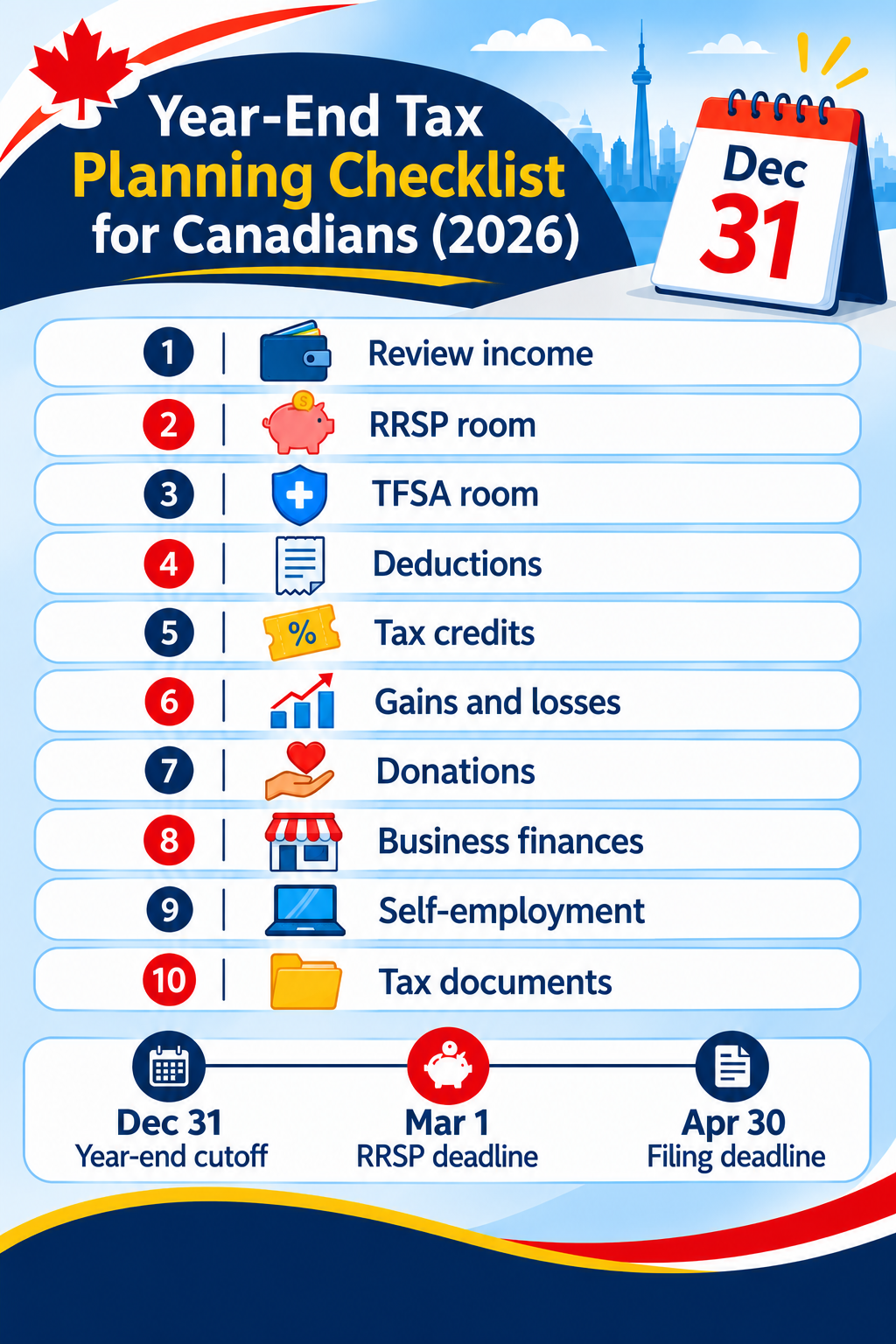
Review Self-Employment Tax Obligations
Self-employed Canadians pay tax on their net business income, and nobody withholds it for you. That makes year-end a good time to work out what you actually earned after expenses and whether you’ve set enough aside. If you’re not sure how your income and expenses should be treated, our page on self-employed tax covers the basics.
Two things catch people out. The first is CPP: when you’re self-employed you pay both the employee and employer portions, though you can deduct part of it. The second is installments.
If your tax owing was above the CRA threshold in the current year and either of the two previous years, you may be required to pay quarterly installments. Missing or underpaying them can lead to interest and penalties.
Even if you’re not required to pay installments, estimating your bill now means you won’t be surprised in April.
Gather your supporting documents while you’re at it: invoices, expense receipts, mileage logs, and records for any home-office claim. If you have a vehicle used partly for business, the log matters more than most people realize.
Organize Your Tax Documents
This is the unglamorous step that saves the most time. Create one folder, paper or digital, and start dropping things in as they arrive. By the new year you’ll want:
- T4 and T4A slips (they arrive by the end of February, but know what to expect)
- Investment statements and any records of trades
- RRSP contribution receipts, including ones for the first 60 days of 2027
- Donation and medical receipts
- Childcare receipts
- Business income and expense records
- Last year’s Notice of Assessment
Scan paper receipts. Photos on your phone work fine if they’re legible. It’s a lot easier to file this as you go than to reconstruct it from your inbox in April. If you’d like a longer, situation-by-situation list, we’ve put together a tax documents checklist for Canadians.
Important Canadian Tax Deadlines to Remember
These are the dates we’d put in your calendar. Please verify each one against current CRA guidance before relying on it or publishing, since dates can shift when they land on weekends or when rules change.
| Item | Date |
| Year-end planning cutoff (donations, most deductions, investment sales settling) | December 31, 2026 |
| RRSP contribution deadline for the 2026 tax year | March 1, 2027 |
| Personal income tax filing deadline | April 30, 2027 |
| Payment of any balance owing (including self-employed individuals) | April 30, 2027 |
| Self-employed filing deadline | June 15, 2027 |
| Tax instalments (if required) | March 15, June 15, September 15, December 15 |
| GST/HST filing | Depends on your reporting period (monthly, quarterly or annual); confirm in CRA My Business Account |
One thing people often get wrong: if you’re self-employed, the June 15 date is for filing, not paying. Any balance you owe is still due April 30, and interest starts accruing after that.
A Simple Timeline to Work Back From
If the list feels like a lot, it helps to spread it out. In November, collect your numbers: income so far, RRSP and TFSA room, and any big sales or purchases. In early December, make the decisions that need to happen this year, such as donations, tax-loss sales and business purchases.
In the last week of December, confirm that nothing is left hanging. Then in January and February, gather slips and receipts and, if you plan to contribute to your RRSP, do it before March 1.
Common Year-End Tax Planning Mistakes to Avoid
The biggest one is also the simplest: waiting until tax season to look at anything. By then, December 31 has come and gone, and the options that depended on it are gone with it.
Overcontributing to a TFSA or RRSP is the other classic. Both have penalties, and both are easy to do accidentally, especially if you have accounts at more than one institution or you’ve made withdrawals earlier in the year. Check your room before you contribute, not after.
We also see people leave real money on the table by missing deductions and credits they qualified for, simply because the receipts weren’t kept.
Others ignore their investment gains and losses until the slips show up, at which point it’s too late to do anything about them.
Blending personal and business expenses into one account is another habit that quietly costs people, either in missed deductions or in awkward conversations if the CRA asks questions.
Then there are missed payment dates. Interest runs from the due date, even when the return itself is filed on time, which is why many people who file in good faith still end up paying more than they expected.
None of these are hard to avoid. They just need a little attention before year-end. Our guide to common tax mistakes in Canada covers more of them if you want the longer list.
Year-End Tax Planning Checklist – Quick Summary
Print this or copy it into your notes:
- Review your annual income from every source
- Check your RRSP contribution room
- Check your TFSA contribution room
- Identify eligible deductions
- Review available tax credits
- Check capital gains and losses
- Organize donation receipts
- Review business expenses
- Organize your tax documents
- Note the upcoming CRA deadlines
Frequently Asked Questions (FAQs)
What is year-end tax planning in Canada?
It’s reviewing your income, deductions, credits and investments before December 31 so you can make decisions that reduce your tax or avoid surprises. Some options expire at year-end, which is why timing matters. Others, like RRSP contributions, can be done a little later, but they still need planning.
What should I do before December 31 for taxes in Canada?
Make any charitable donations you intend to claim, check your TFSA room before contributing, review investment gains and losses, and gather your receipts. If you’re self-employed, tidy up your books too. RRSP contributions can wait until early March, but it’s smart to decide now how much you’ll put in.
Can I reduce my taxable income before the end of 2026?
Often, yes. RRSP contributions are the most common route, and certain deductions like childcare or eligible business expenses reduce income too. What works depends on your situation, so it’s worth confirming before you make a large move. A deduction that saves tax at a high income may do much less at a low one.
What is the RRSP contribution deadline for the 2026 tax year?
March 1, 2027. Contributions made in the first 60 days of 2027 can be deducted on your 2026 return. Confirm the date with the CRA before you act.
How can self-employed Canadians prepare for tax season?
Separate business and personal accounts, keep every receipt, and work out your net income before year-end. Check whether you owe instalments, and remember that your filing deadline is later than most people’s but your payment deadline isn’t.
What tax documents should I collect before the end of the year?
Pay stubs and any early slips, investment statements, RRSP receipts, donation and medical receipts, childcare receipts, and your business income and expense records. Your T4s and similar slips will follow in the new year.
What tax deductions and credits should Canadians review?
Start with RRSP contributions, childcare, moving expenses and business expenses on the deduction side, and medical, tuition and charitable donation credits on the credit side. Provincial credits vary, so check yours.
Get Professional Tax Planning Support from TaxWala
Everyone’s year looks a little different. A new job, a move, a side business or a big investment sale can change which of these steps matters most for you, and an article like this can only speak in general terms. If you’re not sure whether you need an accountant at all, our post on whether you need an accountant for taxes in Canada walks through how to decide.
That’s where we come in. Tax-Wala helps individuals, families, self-employed professionals and businesses with personal and corporate tax preparation, HST/GST filing and tax planning. If something in this checklist raised a question, get in touch with our team before December 31, not after. There’s still time to act on most of this right now.